THE WORLD ON THE STREETS
From South Asia's Revolutions to Europe's October Uprising: Economics, Immigration, Palestine, and the Battle for Political Influence


Governments have fallen in South Asia. Hundreds of thousands are demonstrating in Europe. Palestinian flags have become a recurring symbol of international mobilisation. The United States is confronting its own domestic protests while its foreign policies affect energy markets and security across continents. Is this the beginning of a common global uprising, or are different crises converging in an increasingly unstable international order?
Introduction: Why Are So Many Governments Facing Angry Streets?
In Paris, students are demanding better schools and more affordable living conditions. In Lisbon, workers and young families are protesting housing prices that have increasingly outpaced their incomes. In Milan, demonstrations over war and living costs have escalated into serious confrontations with police. Meanwhile, Berlin and London have witnessed large Palestine solidarity marches, with Palestinian flags and criticism of Western support for Israel prominent in the streets.
Thousands of kilometres away, the recent histories of Sri Lanka, Bangladesh and Nepal offer a warning about how quickly seemingly limited grievances can become political crises.
The common denominator is not necessarily ideology, religion or a foreign government. It is the interaction of economic pressure, political distrust, generational expectations, international conflict and modern digital communication.
But another question has entered public debate: Are the demonstrations part of a wider organised campaign? Has Muslim immigration transformed Europe's protest politics? Are American policies helping create the conditions for unrest? Is Israel's military conduct turning Palestine into a global rallying point?
The evidence produces a more complex picture than any single explanation.
Europe is not experiencing one uprising. It is experiencing several distinct protest movements in the same period, some connected through shared grievances and others through international solidarity.
1. The Roots of Contemporary Unrest: Sri Lanka, Bangladesh and Nepal

Sri Lanka — July 2022
Economic collapse, fuel shortages, inflation and public anger culminated in the resignation of President Gotabaya Rajapaksa.

Bangladesh — August 2024
Demonstrations against government job quotas escalated after deadly confrontations, ending with Prime Minister Sheikh Hasina's resignation.

Nepal — September 2025
A social-media ban triggered wider anger over corruption and employment opportunities. Prime Minister K. P. Sharma Oli subsequently resigned.
Sri Lanka: An Economic Crisis That Became a Political Crisis
Sri Lanka's 2022 Aragalaya movement did not begin with an elaborate geopolitical manifesto. It emerged from a concrete breakdown in everyday economic life. The country faced a severe shortage of foreign currency, fuel, medicines and other imports. Power cuts and rising prices brought households and businesses under extraordinary pressure.
Eventually, protesters occupied key government buildings, and President Gotabaya Rajapaksa resigned.
The event demonstrated that a government's ability to maintain basic economic functions is central to its legitimacy. Once citizens conclude that essential services are failing and political leaders cannot restore them, economic dissatisfaction can evolve into a demand for political change.
Bangladesh: How a Recruitment Dispute Escalated
The 2024 Bangladesh movement originated in opposition to quotas for government employment. The immediate issue concerned access to jobs, but the protests gradually became a broader confrontation over state accountability and political authority.
On 4 August 2024 alone, Reuters reported at least 91 deaths in clashes, including police officers. By the following day, Sheikh Hasina had resigned and left the country.
The important lesson is that protest demands can change during confrontation. Once a movement begins demanding accountability for deaths, detentions or alleged abuses, withdrawing the original disputed policy may no longer settle the crisis.
Nepal: When Digital Restrictions Became a Political Trigger
In September 2025, Nepal's restrictions on major social-media platforms triggered demonstrations, largely involving young people already frustrated by corruption and limited employment opportunities.
Reuters reported at least 19 deaths on the first day of major unrest. The government later withdrew the social-media restrictions, but the protests continued and Prime Minister Oli resigned.
Nepal highlighted the political importance of digital communication. Social networks are not merely platforms for entertainment; they help citizens organise, communicate grievances and share evidence of events.
Nevertheless, technology was a mobilising mechanism, not a complete explanation. The underlying grievances already existed.
Together, these three cases demonstrate how economic insecurity, perceived political privilege and contentious government responses can transform limited disputes into national crises. They do not establish that a single foreign actor orchestrated all three uprisings.
India, October 2026: The CJP Protests and the Battle Over Electoral Credibility

India has also witnessed a youth-led protest movement in October 2026, demonstrating how grievances over employment, political accountability and electoral procedures can generate public mobilisation. The Cockroach Janta Party (CJP), led by activist Abhijeet Dipke, has organised demonstrations questioning the Election Commission's Special Intensive Revision (SIR) of electoral rolls and demanding the resignation of Chief Election Commissioner Gyanesh Kumar.
The movement emerged against a backdrop of earlier protests concerning examination irregularities and employment opportunities. Its latest campaign, however, focuses primarily on electoral transparency. Protest organisers allege that large-scale voter-list revisions have excluded eligible citizens and could disadvantage particular communities. The Election Commission maintains that the revision is intended to remove ineligible entries and improve the accuracy of electoral registers. These competing claims are central to the controversy and must not be confused with independently established findings of electoral manipulation.
On 10 October, protesters attempting to gather at Delhi's Jantar Mantar encountered extensive security restrictions, barricades and police deployments. Demonstrators subsequently organised smaller gatherings at Connaught Place, Dilli Haat, Raj Ghat and other locations. The Indian Express documented these decentralised demonstrations and the detention of participants.
The confrontation continued on 16 October during the CJP's Lehra Do Tiranga campaign. Reuters reported that approximately 500 demonstrators gathered across parts of Connaught Place despite restrictions. Several protesters, including Dipke, were detained. The Indian Express subsequently reported that more than 100 people had been detained and multiple FIRs registered in connection with the demonstrations. Police cited public-order concerns and alleged violations of prohibitory orders.
On 20 October, United Nations human rights experts called for an independent investigation into reports of excessive force during recent Indian demonstrations. Indian authorities maintained that policing measures were necessary to preserve public order. These developments have brought questions about the right to peaceful assembly, electoral administration and public security into sharper focus.
What Makes India's CJP Protests Significant?
India's CJP movement shares certain characteristics with the youth-led demonstrations previously witnessed in Nepal and Bangladesh, particularly the use of digital mobilisation, dissatisfaction with established political institutions and demands for procedural accountability.
However, significant differences remain. India continues to operate through established constitutional, judicial and electoral institutions, and the CJP demonstrations have not reached the scale or produced the political outcomes associated with the earlier uprisings in Nepal and Bangladesh.
The movement is therefore best understood as a distinct domestic political protest rather than proof of a coordinated international Gen Z uprising.
The Indian experience reinforces an important lesson: public confidence in transparent recruitment, electoral procedures and institutional accountability can influence political mobilisation even when the underlying disputes differ substantially between countries.

2. October 2026: Europe's New Protest Wave

Europe's latest unrest is especially notable because it is unfolding across several established democracies with different political systems and economic conditions.
On 17 October 2026, major demonstrations occurred in France, Italy, Belgium and Portugal. Spain and Albania have also experienced significant mobilisation around domestic issues.
The immediate grievances vary by country.

France: The Epicentre of the October Demonstrations
France experienced some of the largest demonstrations. Reuters reported a turnout of approximately 550,000–800,000 people in nationwide protests on 17 October, with estimates varying by reporting source.
What started with grievances over inadequate school conditions and education funding expanded to include cost-of-living pressures, wider public-service dissatisfaction and participation by trade unions and other groups.
A portion of the demonstrations deteriorated into serious violence, including arson, looting and attacks on public infrastructure. Reuters reported more than 1,200 arrests in its initial account and over 150 injured police officers. Those figures are snapshots from specific reporting times, not final cumulative totals.
France also demonstrates why it is essential to differentiate peaceful protesters from individuals participating in criminal violence. The presence of both in the same city does not make them one organised group.
Italy: When Economic Demonstrations Turn Violent

In Milan, demonstrations relating to economic hardship and war began peacefully but were followed by serious violence. Groups of masked individuals clashed with police, and property was damaged or looted.
Prime Minister Giorgia Meloni condemned the disorder, declaring:
“Demonstrating is a right. Setting our cities ablaze is not.”
The quotation was reported by Al Jazeera on 17 October.
the Italian government had approved additional security measures following the riots, including a proposed new offence for violent participation in demonstrations and the deployment of more soldiers in Milan.
The Italian case shows how legitimate economic demonstrations and criminal disorder can coexist. Determining who organised the violence requires evidence about particular individuals and groups, not assumptions about all participants.
Portugal: The Housing Crisis as a Political Trigger

In Portugal, the grievance is particularly concrete: housing.
house prices had more than doubled since 2017, while rents for new leases had risen by almost as much. Demonstrators criticised low wages and the difficulty of obtaining housing in major cities.
For younger Europeans, housing costs represent more than another consumer expense. They influence family formation, financial independence, employment mobility and wealth accumulation.
A generation that cannot afford to establish independent households may question whether the economic system is delivering the opportunities traditionally associated with work and education.
Belgium and Albania: Different Countries, Different Triggers
Belgium has witnessed student demonstrations concerning educational fees and funding. Police used water cannon during confrontations in Brussels and Liège.
Albania's unrest has focused more heavily on corruption, unemployment, education and a controversial development proposal associated with an investment company linked to Jared Kushner, President Donald Trump's son-in-law.
These events illustrate an important limitation in the claim that Europe is experiencing a coordinated revolt.
Similar timing does not demonstrate common political leadership. Distinct domestic grievances can become visible simultaneously because countries face overlapping economic challenges and because media coverage amplifies events across borders.
3. The Data Behind Europe's Economic Anger

There is a second economic indicator worth considering: the cost of government borrowing.
On 21 October, Reuters reported that French ten-year government bond yields had climbed to approximately 4.948%, reflecting increased market concerns amid political unrest and fiscal pressures. The spread over German government bonds had widened to around 150 basis points
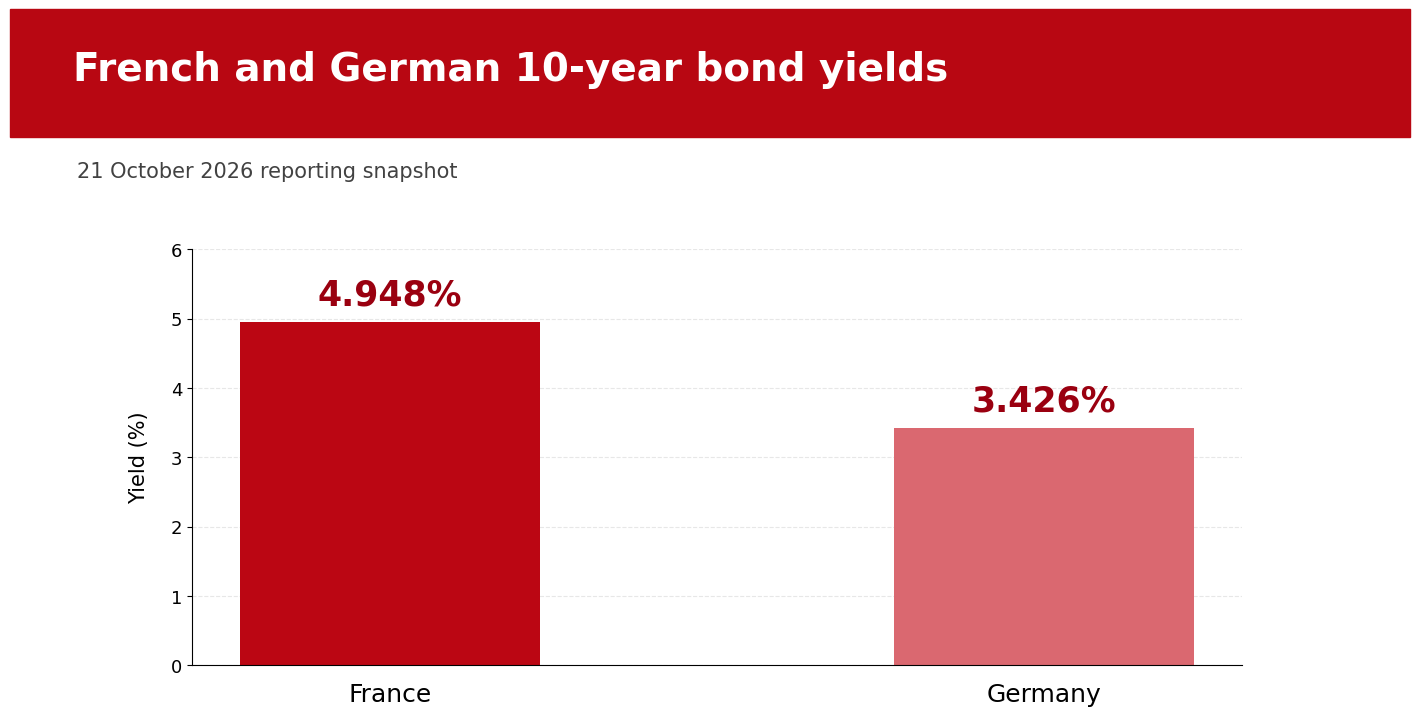
This matters because prolonged instability can influence borrowing costs, investment expectations and business confidence.
Higher borrowing costs can also complicate governments' ability to increase public spending—the very response some demonstrators demand.
The result is a difficult fiscal equation: political pressure for increased services at a time when financing those services may be becoming more expensive.
4. The Palestinian Flag: Why Has It Become So Visible in European Streets?

While economic demonstrations have captured headlines in October, a separate and longer-running mobilisation has centred on Gaza, Palestine and Western relations with Israel.
These protests have brought Palestinian flags into public spaces in London, Berlin, Madrid, Rome, Paris and numerous other cities.
But how extensive is this movement?
Measuring the Movement: ACLED's Protest Data
ACLED, an independent conflict and protest monitoring organisation, recorded more than 930 pro-Palestine and anti-Israel demonstration events across Europe in October 2025. More than half were recorded in Italy and Spain.
The organisation linked the increase in mobilisation partly to the interception of the Global Sumud Flotilla, which was attempting to deliver humanitarian aid to Gaza.
ACLED also documented police dispersal or confrontation at a minimum of 36 events in 11 European countries during that month, while stating that the vast majority of gatherings remained peaceful.

The distinction between an event and a participant is essential. A demonstration attended by 3,000 people and another attended by 100,000 people each count as one event in an event-based dataset.
Likewise, the number of demonstrations is not the number of Palestinian flags displayed.
So How Many Palestinian Flags Were Displayed in October 2026?
There is no verified, consolidated European count of Palestinian flags displayed at demonstrations during October 2026.
Reliable photographs establish that they were prominently displayed at identified pro-Palestine events, but not a numerical continent-wide total.
For example, on 10 October 2026, a pro-Palestinian demonstration took place near Berlin's Federal Chancellery under the slogan United4Palestine. The police estimated around 3,500 participants, while organisers claimed a higher turnout. News photographs show Palestinian flags and banners criticising Israel and German support for the Israeli government.
The same day, Reuters filmed a march in London, showing Palestinian flags, demonstrators passing Big Ben and placards calling for British action on arms exports to Israel.
These photographs document mobilisation, but they cannot determine the proportion of Muslim participants, the number of religious organisations involved or the extent of foreign influence.
The Palestinian flag is evidence of a political message. It is not, by itself, evidence of religious identity, Islamist affiliation or external control.
5. Global Palestine Demonstrations: The Historical Numbers
The Palestine movement's international reach is evident in ACLED's data for the period from 7 October 2023 to 28 June 2024.

One finding is especially revealing: the United States ranked second in this historical dataset, with 3,656 recorded demonstrations.
This matters because it challenges the assumption that Palestine solidarity is confined to Muslim-majority societies. Protest activity appeared in American universities, major cities and communities across all 50 states and Washington, DC.
The demonstrators included groups with different political and religious identities.
A pro-Palestinian position can stem from humanitarian concerns, opposition to specific Israeli military operations, Palestinian nationalism, anti-war politics, religious solidarity or opposition to US foreign policy.
These motivations may overlap, but they are not interchangeable.
6. Is the Movement Pro-Palestine, Pro-Islam or Islamist?
This question requires unusually careful definitions.
Pro-Palestinian activism generally advocates Palestinian rights, statehood, humanitarian protection, or changes to Israeli and Western policies.
Muslim solidarity activism refers to mobilisation grounded partly in shared religious identity and concern for Muslim communities.
Islamist political activism refers to political movements seeking to organise government or society around particular interpretations of Islam.
These categories can intersect, but belonging to one does not automatically imply belonging to another.
The Religious Dimension Is Real
For many Muslims, Jerusalem and the Al-Aqsa Mosque possess profound religious significance. Events in Gaza and Jerusalem can therefore have religious as well as political resonance.
Muslim civil-society organisations may organise marches, raise funds, advocate humanitarian assistance and call for policy changes.
This is a legitimate subject for examining protest mobilisation.
But a demonstration featuring Palestinian flags does not establish that it is led by an Islamist organisation. Organiser identities, public demands, funding records and affiliations must be investigated separately.
Likewise, the fact that a movement includes secular, Jewish, Christian or other non-Muslim participants does not eliminate the involvement of religiously motivated activists.
A mixed coalition can contain several motivations simultaneously.
What Would Constitute Evidence of Islamist Direction?
A defensible investigation would require documented organisational leadership, relevant financial relationships, identifiable endorsements, internal communications or credible findings concerning particular groups.
A religious slogan, the appearance of an Islamic symbol or the presence of Muslims in a crowd is not sufficient to establish organisational control.
At the same time, any credible evidence of a designated extremist organisation financing, directing or exploiting a protest should be examined without dismissing it.
The correct standard applies equally to every ideological movement: organisation and direction must be demonstrated, not inferred from identity.
7. Is Europe's Growing Muslim Population Causing the Protests?
This demographic question can be tested with published evidence.
Pew Research Center's June 2025 study found that Muslims represented approximately 6% of Europe's population in 2020. The proportion had increased by less than one percentage point since 2010.
The study also found that Europe's religiously unaffiliated population had grown markedly, while Christian identification declined.


The figures establish that Europe's Muslim population grew, with migration contributing to the increase. They do not establish that this increase caused the October 2026 riots.
Immigration is nevertheless an important political issue in Europe. Countries face genuine debates concerning asylum policy, housing capacity, integration, border enforcement, religious freedom and social cohesion.
But those debates must be connected to particular protest events using evidence.
On 21 October 2026, Associated Press examined claims by President Donald Trump and other American Republicans that Muslim immigrants were responsible for France's unrest. AP reported that the claims lacked supporting evidence and that some viral allegations involving religious attacks were demonstrably false.
French President Emmanuel Macron rejected the attempts to attribute the disorder to migrants. Authorities were continuing to investigate the violence.
The conclusion is therefore specific:
Immigration-related political conflicts exist in Europe, but available evidence does not establish Muslim population growth as the primary cause of the October 17 demonstrations in France, Italy, Belgium and Portugal.
8. How the Palestine Issue Enters European Domestic Politics
The Palestine issue has become politically consequential inside several European countries because it connects foreign policy with domestic political participation.
Campaigns may target arms exports, government diplomatic positions, recognition of Palestinian statehood, university investments or policing decisions surrounding demonstrations.
For example, the organisers of the Berlin demonstration on 10 October demanded an end to German arms supplies to Israel and stronger protection for Palestinian political expression.
In London, Reuters filmed demonstrators carrying banners that called for Britain to stop arming Israel and impose sanctions.
These demands directly concern domestic policy decisions, even though the conflict prompting them is international.
That helps explain how a war in the Middle East can become a subject of debate in European parliaments, campuses, streets and elections.
However, it would be misleading to merge these demonstrations with unrelated movements over school funding or housing simply because they occur in the same month.
The analytical question is not whether Palestine is visible. It clearly is.
The important question is where, when and through which organisations Palestine-related demands intersect with other political movements.
9. The United States: A Foreign Influence, an Economic Power and a Country Experiencing Its Own Protests

The United States enters the protest story through three distinct channels.
The first is foreign policy. Washington's political and military relationship with Israel has made American decisions a direct target of Palestine solidarity campaigns.
The second is economic influence. American trade policy, financial conditions and security decisions can affect the global economy, including European growth and inflation.
The third is political messaging. Statements by American leaders can influence international debates, even when they concern events inside other countries.
How American Policies Create International Economic Consequences
The clearest measurable connection between international conflict and present European economic pressures is energy.
On 21 October 2026, Reuters reported Brent crude oil near $110.11 per barrel amid further concerns about the security of Middle Eastern shipping routes and attacks on commercial vessels.

Oil prices influence fuel expenses, shipping, production and potentially wider consumer inflation. European economies can face higher costs even when their governments are not directly involved in the conflict.
But it is important to separate an indirect economic consequence from a deliberate political operation.
American policy can affect the economic environment in which protests occur. That does not demonstrate that American agencies organised the demonstrations themselves.
American Political Messaging: The France Immigration Controversy
The October riots have also become part of American domestic political debate.
Associated Press reported on 21 October that President Trump and other Republican figures attributed the French violence to Muslim immigrants without supporting evidence.
The controversy illustrates how unrest in one country can be reframed through another country's political priorities, especially during an election period.
This is a documented example of international narrative influence: American political statements helped introduce a migration-related explanation into the debate over French disorder.
But it remains distinct from evidence of operational involvement in the events on the ground.
Did Washington Secretly Finance or Direct These Protests?
No verified evidence identified in the reviewed sources establishes that the US government coordinated the current European cost-of-living demonstrations or directed the protest movements that brought down governments in Sri Lanka, Bangladesh or Nepal.
Historical American involvement in foreign political processes is a legitimate subject of research. It does not prove involvement in any particular 2026 event.
A serious investigation would require records of funding to named organisers, authenticated communications, official directives, credible intelligence disclosures or other independently verifiable evidence.
Claims about foreign involvement should be evaluated at that standard.
10. Israel's Role: Why Gaza Has Become a Global Political Issue

Israel's military operations and the wider regional conflict have shaped international political mobilisation in ways that extend far beyond the Middle East.
The strongest evidence of direct impact lies in demonstrations expressly opposing Israeli military policy and Western governments' support for Israel.
In such cases, the connection is explicit: protest organisers state demands concerning Gaza, Palestinian rights, military exports and diplomatic policy.
But the wider effect of conflict also operates through energy prices, shipping costs and public fears about further regional escalation.
These are indirect pressures that can intensify existing economic grievances.
How the Influence Travels

These mechanisms should not be confused.
A march calling for an arms embargo on Israel is directly associated with foreign policy. A housing demonstration in Portugal may be influenced indirectly by energy or construction costs, but its underlying affordability problems predate the present crisis.
Israel's actions have demonstrably become an issue in international protest mobilisation. The evidence reviewed does not, however, establish that Israel directed Europe's economic demonstrations or that Israeli policy is their sole cause.
11. Foreign Interference, Propaganda and Information Operations: What Can Actually Be Established?
This is perhaps the most important issue for strategic communication analysts.
An international crisis can create opportunities for foreign governments, political parties, activist networks and commercial platforms to amplify narratives that advance their interests.
However, four activities must remain analytically distinct.

The available October 2026 sources establish some instances of public political messaging and international activist mobilisation.
They do not establish a single covert foreign command structure behind Europe's economic protests, Palestine solidarity demonstrations and South Asia's earlier uprisings.
Why Viral Videos Are Especially Problematic
A video of Palestinian flags at a march in London can be authentic but misleading when reused to describe an unrelated demonstration in France.
A picture of violence in Milan cannot establish the motivations of all participants at the original peaceful march.
A political statement blaming immigrants or foreign intelligence organisations cannot be treated as corroboration of those allegations.
Reliable open-source analysis requires original publication dates, geographical verification, event identification, source comparison and independent corroboration.
The information environment can magnify protests, but virality is not proof of foreign control.
12. Can the Current Protests Be Compared With the Arab Spring?

The Arab Spring offers a useful historical comparison, but also highlights the danger of overgeneralisation.
Beginning in Tunisia in late 2010, demonstrations spread across several Arab countries. Economic hardship, unemployment, corruption and opposition to authoritarian political systems were significant factors.
Digital communication and international news coverage helped transmit protest narratives between countries.
But subsequent outcomes differed dramatically. Some governments fell, some political systems survived, and several societies experienced prolonged instability or armed conflict.
The same caution applies to 2026.
Sri Lanka, Bangladesh and Nepal experienced leadership changes following major protests. France, Italy and Portugal are facing pressure through different institutional and political mechanisms.
In established democracies, protests may influence legislation, government spending, public debate or elections without necessarily producing revolutionary changes.
The comparison is most useful for examining how grievances spread and how governments respond. It is not evidence that identical political outcomes will follow.
13. India: What Does the Global Protest Wave Mean for Its Strategic Environment?
India has a particular interest in these developments because it is exposed to both regional political instability and international economic shocks.
The earlier upheavals in Sri Lanka, Bangladesh and Nepal took place in India's immediate neighbourhood. Each created questions concerning regional diplomatic engagement, border management and economic stability.
At the same time, current disruptions in Middle Eastern energy markets affect India's import costs and maritime-security interests.
Several practical implications emerge.
First, economic resilience matters for political stability. Affordable living conditions, accessible education, employment opportunities and responsive institutions can influence public confidence.
Second, energy and maritime security are connected. Instability in Gulf shipping routes can impose economic costs far beyond the conflict region, including on major energy importers such as India.
Third, regional instability should be assessed country by country. The domestic causes of the Bangladesh, Nepal and Sri Lanka movements were distinct. A common external sponsor cannot be inferred merely from geographical proximity.
Fourth, strategic communication requires distinguishing legitimate civic mobilisation from documented manipulation. A hostile information operation should be identified through verifiable networks and conduct, not through assumptions about the religion, ethnicity or political opinions of protesters.
India's strongest analytical advantage lies in recognising the economic, political and information dimensions of unrest without treating them as interchangeable.
14. Evidence Assessment: Which Explanations Are Supported?

15. Conclusion: The Crisis Is Wider Than Any Single Ideology
The most revealing feature of the present international protest environment is not that people are angry. Public dissent is a recurring feature of political life.
What distinguishes the current period is the number of different pressures converging at once.
Households are experiencing persistent affordability problems. Younger generations are questioning access to education, housing and stable careers. International wars are affecting energy supplies and foreign-policy debates. Governments face difficult fiscal choices, while digital platforms transmit images of discontent across borders almost instantly.
The Sri Lankan, Bangladeshi and Nepali experiences demonstrate that serious grievances can escalate into political crises when institutions lose the confidence of significant sections of society.
Europe's October demonstrations reflect a different, but related, problem: citizens in developed economies are questioning whether established systems can deliver economic security and responsive public services.
The Palestine movement introduces another dimension. It demonstrates how international conflict can become a domestic political issue across countries with different religious and demographic compositions.
And immigration remains an important, contested political subject but the evidence does not support reducing all these distinct movements to Muslim demographic growth.
Neither does it support attributing the global protest wave to an established US or Israeli covert operation.
The more significant analytical finding is that economic insecurity, international conflict, political mistrust and digital mobilisation can reinforce one another without requiring a single central organiser.
That makes the present environment difficult for governments to manage. Addressing an economic grievance does not necessarily resolve a dispute over foreign policy. Restricting a violent crowd does not resolve a housing shortage. Countering disinformation does not automatically restore confidence in public institutions.
The challenge for governments is therefore not simply to control the streets. It is to understand which grievances are real, which narratives are being amplified, which groups are organising legitimate political activity and where independently verifiable manipulation exists.
The world may not be witnessing one coordinated revolution. It is witnessing multiple tests of whether political systems can respond to citizens living under simultaneous economic, social and geopolitical pressures.